
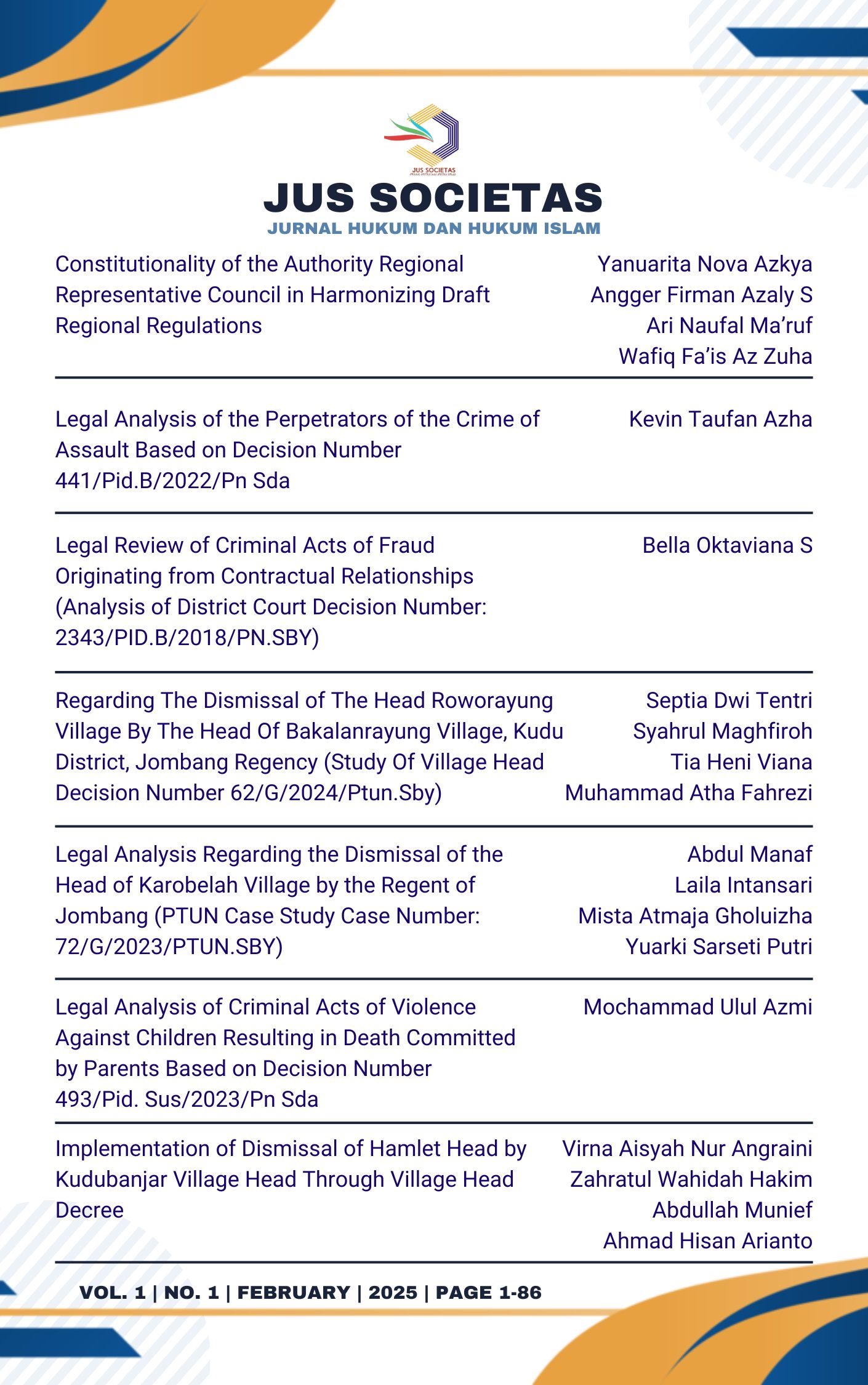
Analisis Hukum Terhadap Pelaku Tindak Pidana Pengeroyokan Berdasarkan Putusan Nomor 441Pid.B/2022Pn Sda
Published 2025-03-15
Keywords
- Criminal Assault, Criminal Law Theory, Substantive Justice, and Procedural Justice
Copyright (c) 2025 Kevin Taufan Azhar (Author)

This work is licensed under a Creative Commons Attribution 4.0 International License.
Abstract
According to criminal law theory, Article 170 paragraph (1) of the Criminal Code stipulates the elements of the crime of ganging up that must be fulfilled for prosecution. These elements include (1) "whoever" as the legal subject, (2) actions "openly and with joint force using violence", and (3) actions "against people or goods that result in injury". This study analyzes how the Panel of Judges applied these elements in the decision of this case and considered both legal aspects (such as witness statements and evidence) and non-legal elements (such as the defendant's social and psychological background). The results of the study show that although the judge's decision is in accordance with the provisions of Article 170 paragraph (1) of the Criminal Code, the sentence imposed, namely 1 year in prison, is relatively lighter than the demands of the Public Prosecutor who asked for a sentence of 1 year and 8 months. The author argues that this decision shows law enforcement that tends to pay more attention to the principle of individual justice than social justice. From the perspective of criminal law theory, punishment must not only uphold norms but also function as a tool to prevent crime and provide a deterrent effect for perpetrators. The effectiveness of sentencing must take into deeper consideration the aggravating and mitigating factors and the implications of justice for society as a whole. This is important to create a balance between fulfilling the rights of the accused and protecting society.
References
- Andi Hamzah, 2006, Hukum Acara Pidana Indonesia, Sinar Grafika Offset, Jakarta.
- Bambang Purnomo, 2001, Orientasi Acara Hukum Pidana Indonesia, Amarta, Yogyakarta.
- Barada Nawawi A, 2010, Kebijakan Legislatif Dalam Penanggulangan Kejahatan Dengan Pidana Penjara, Genta Publishing, Yogyakarta.
- D. Schaffmeister, 2011, dkk, Hukum Pidana, Citra Aditiya Bakti, Bandung.
- Farhana, 2010, Aspek Hukum Perdagangan Orang di Indonesia, Sinar Grafika, Jakarta.
- Rodliyah, 2017, Hukum Pidana Khusus, Raja Grafindo Persada, Depok.
- Ismu Gunadi dan Jonaedi Efendi, 2014, Hukum Pidana, Kencana, Jakarta.
- Leden Marpaung, 2000, Proses Penanganan Perkara Pidana, Sinar Grafika, Jakarta.
- Laden Marpaung, 2005, Asas-Teori-Praktik Hukum Pidana, Sinar Grafika, Jakarta.
- Moeljatno, 2002, Asas-Asas Hukum Pidana, Rineka Cipta, Jakarta.
- Moeljatno, 2018, Kitab Undang-Undang Hukum Pidana, Bumi Aksara, Jakarta.
- Moeljatno, 2008, Asas-Asas Hukum Pidana, Rineka Cipta, Jakarta.
- Satjipto Rahardjo, 2010, Masalah Penegakan Hukum, Sinar baru, Bandung.
- Soenarto Soerodibroto, 2000, KUHP dan KUHAP dilengkapi Yurisprudensi, Mahkamah Agung, Hoge Raad Edisi Empat, Raja Grafindo Persada, Jakarta.
- Teguh Prasetyo, 2010, Hukum Pidana, Raja Grafindo Persada, Jakarta.
- Wirjono Prodjodikoro, 2003, Asas-Asas Hukum Pidana Di Indonesia, Cet III: Eresco, Jakarta.
- Vieta Imelda Cornelis, 2023. Bureaucracy Journal: Indonesia Journal of Law and Social Political Governance, Vol.3.No.3.
- Wahyu Prawesthi, 2024, Politik Hukum Pidana Terhadap Penanggulangan Kejahatan Illegal Loging, Jurnal Hukum, Vol.3. No.3, hlm.10-13, hlm.2650-2666.
- Undang-Undang Dasar Negara Republik Indonesia Tahun 1945.
- Undang-Undang Nomor 1 Tahun 1946 Tentang Peraturan Hukum Pidana (Kitab Undang-Undang Hukum Pidana).
- Undang-Undang Nomor 8 Tahun 1981 Tentang Kitab Undang-Undang Hukum Acara Pidana (KUHAP).